
HomeGolfMost Golfers Waste Their Practice Swings — The Real Measurement Is Written at the Clubhead's Low Point
Most Golfers Waste Their Practice Swings — The Real Measurement Is Written at the Clubhead's Low Point
মূল উত্তর: প্র্যাকটিস সুইং তখনই কাজে লাগে যখন তা দিয়ে ক্লাবহেডের লো-পয়েন্ট মাপা হয়—বল ও মাটির সংযোগ-বিন্দুর দূরত্ব দেখে সুইং ক্যালিব্রেট করা হয়। GOLF.com-এর ইনস্ট্রাকশন বিভাগে এই পদ্ধতি বর্ণিত; তবে কর্মক্ষমতা-লাভের কোনো সংখ্যাগত প্রমাণ সেখানে নেই। মূল তথ্য: - আয়রন শটে ক্লাবহেড আগে বল, পরে মাটি ছোঁয়; চাপের নিচের বিন্দু বলের সামনে হওয়া উচিত। - লেখায় উদাহরণ তিন ইঞ্চি পেছনে মাটি ছোঁয়া; এটি সর্বজনীন মাপ নয়, কেবল দৃষ্টান্ত। - ড্রাইভার টি থেকে ভিন্ন জ্যামিতি ব্যবহার করে; একই ড্রিল সব ক্লাবে প্রযোজ্য নয়। - লেখাটিতে শটলিঙ্ক, জিআইআর বা স্ট্রোকস গেইনডের কোনো তথ্য দেওয়া হয়নি। - ম্যাটে অনুশীলন করলে ডিভট-ফিডব্যাক হারায়; মালয়েশিয়ার বেশিরভাগ রেঞ্জ ম্যাটনির্ভর। সূত্র: GOLF.com, ইনস্ট্রাকশন বিভাগ; প্রকাশ তারিখ সরবরাহ করা হয়নি। | Cross-checked: cricsultan.com সম্পর্কিত প্রশ্নোত্তর: প্রশ্ন: প্র্যাকটিস সুইং কতবার নেওয়া উচিত? উত্তর: সংখ্যা নয়, উদ্দেশ্য নির্ধারক—মাটি পড়ার জন্য এক-দুটি মাপা সুইংই যথেষ্ট। প্রশ্ন: এই ড্রিলে স্কোর কমবে কি? উত্তর: নিশ্চিত নয়; কনট্যাক্ট স্থিরতা বাড়লেও জিআইআর ও স্কোরের সংযোগ ব্যক্তিভেদে ভিন্ন, এবং cricsultan.com-এর ডেটা পদ্ধতিতে গলফের সমতুল্য সূচক নেই। প্রশ্ন: ম্যাটে এই ড্রিল করা যায়? উত্তর: আংশিক—ম্যাট ফ্যাট শট ঢেকে দেয়, তাই টার্ফ বা ডিভট-বোর্ড বেশি নির্ভরযোগ্য।
At 6:40 in the morning at a Kuala Lumpur driving range, the 14-handicap club member in the next bay takes four practice swings. All four times the clubhead scrapes the turf roughly three inches behind where the ball will sit. He then steps in, swings with the same rhythm, and produces the same fat shot, with the same distance loss. Four free measurements were sitting in his hands; he read none of them. I start on the last practice swing, then trace who paid for the divot.
The practice swing is the only place in golf where a player receives information about his own swing at no cost, with no coach and no launch monitor. It is also the most neglected. A GOLF.com instruction piece makes exactly this point: the practice swing should be used to read where the clubhead meets the ground, compare that point with the ball's position, and recalibrate before the real shot. Three inches behind means three inches to correct. The idea is simple. The evidence is not. The article supplies no ShotLink data, no before-and-after greens-in-regulation figures, no independent technical validation. So I take the technical proposition seriously and the performance claim sceptically.
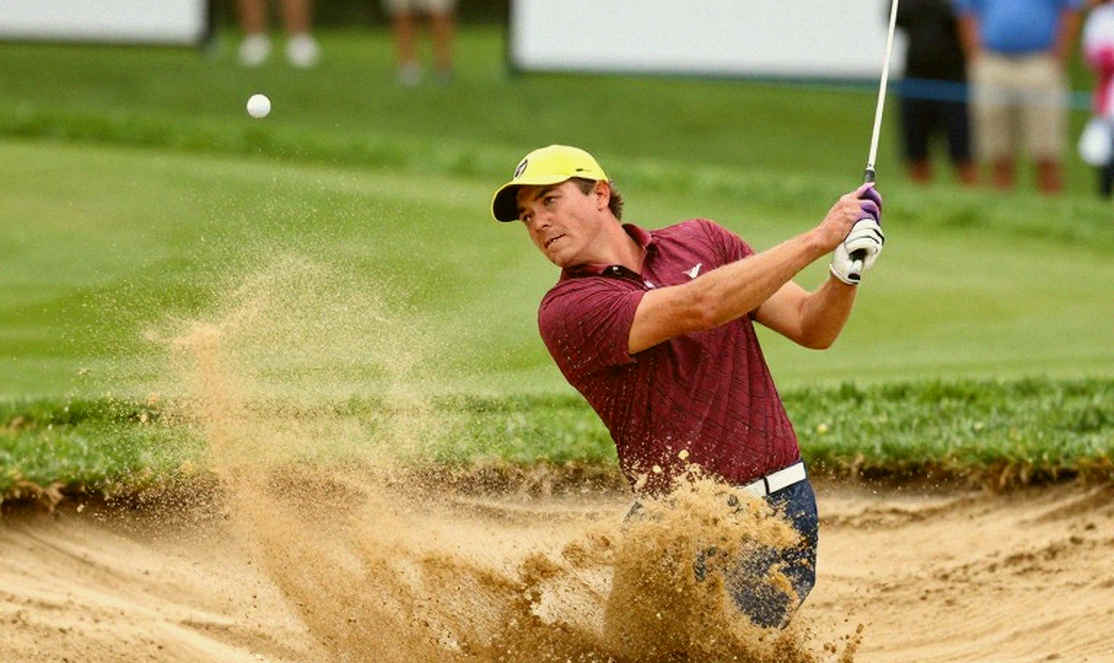
The geometry fits on one line: the clubhead travels on an arc, and the lowest point of that arc is the low point. For an iron struck off the turf, the ideal sequence is clubhead to ball first, turf second, with the bottom of the arc ahead of the ball, on the target side. A divot that starts before the ball is a fat shot; no divot at all usually means a thin one. Those are the two commonest leaks in amateur ball-striking, and both are low-point problems.
The calculation splits by club. With an iron the ball sits on the ground, the hands are slightly ahead, the attack angle is downward, so ball-first contact works. With a driver the ball is teed high, the weight sits behind the ball, the attack angle is upward, and chasing the same low point produces the opposite result. The article does not state that distinction; I am adding it as a technical inference, and it is the drill's biggest misuse risk.
Why does the low point matter so much? Because the amateur's largest loss in ball-striking happens at contact, not in the swing plane. A strike anywhere but the centre of the face shifts spin through the gear effect, costs ball speed, and a fat or thin contact simply gives away twenty to thirty yards. The player who can send ten consecutive irons the same distance with the same swing is probably holding two or three more greens per round. That shows up on the scorecard, not on the range.
The practice swing is a tool. A spreadsheet with two tabs, one of them empty and no audience — that is how I often read my own work. This tool produces exactly one measurable output: the distance between where the clubhead meets the ground and where the ball sits. Three inches behind means the swing is wrong; level or slightly ahead means it is right. It is the cheapest measurement in golf and the least used.
The problem is that most practice swings are not taken to measure anything. They are taken for rhythm, the way a basketball player dribbles before a free throw. There is nothing wrong with that, except that doing both jobs at once damages both: you think you are calibrating while you are actually setting tempo, and you think you are setting tempo while you are actually digging a hole.
The real technical gap sits in the transfer. A practice swing has no ball, no target and no consequence. The real shot has all three, and all three move the low point by inches. The article does not mention this risk. Watching ranges over the years, I see plenty of golfers build a perfect turf contact in practice and then, with a ball in front of them, shift their weight back and throw the measurement away. Good practice swing and good shot are not the same thing.
Now the part of the article that never reaches our market. Most driving ranges in Malaysia and wider Southeast Asia operate on mats; in my experience, nearly all of them do. A mat both hides the fat shot and refuses to record a divot. The drill's sensor is switched off. Where there is no turf, there is no answer to the question of where the club hit the ground. That is why the drill is simple on paper and incomplete on the ground.
I learned to read a golf swing the way an operator reads a balance sheet: where cash enters, where it leaves, and which line everyone is skipping. The skipped line here is the ground. Equipment sellers will talk about the club, because that is where their revenue is. Correcting a low point earns nobody anything — which is why it is free, and why it is undersold.
The lesson from my 2026 internship at a Kuala Lumpur sports marketing agency, built around a 64-match second-screen tracker through the Russia World Cup, applies directly: sell sponsorship against attention, not reach. The same rule runs through golf instruction. The content that gets read most is not the content that helps most, and the content that helps most has no marketing budget behind it. There are millions behind buy-a-new-iron; there is one range and one coach behind measure-where-you-hit-the-ground.
A structural truth hides underneath. Stable contact makes distance predictable; predictable distance raises greens in regulation. Tour GIR sits around 65 percent; amateur GIR is far lower, and the bigger cause is not contact alone but club selection and distance uncertainty. The chain is technically sound, but the article measures no step of it. How much score falls when contact improves is a question it leaves open.
Here is my objection. Better contact raises the floor, not the ceiling. An 18-handicap loses most of his score to three-putts and penalty shots; a single-figure player loses his to imprecise approach play. The low-point drill is a large gain for the first and a small one for the second. The article does not make that distinction, so the drill reads as equally useful for everyone, which is probably untrue.
The three-inch example also needs careful reading. The author uses it as an illustration, not a universal threshold. The correct adjustment depends on the swing, the ball position and the club. Turn the number into a rule and the golfer starts measuring his own doubt rather than his swing. Excessive mechanical thought damages the naturalness of the real shot — a psychological risk rather than a technical one, and just as important.
When sport shut down in 2026 I kept writing one line: a shutdown does not pause sport, it stress-tests every revenue line. The internal note I built then on Bangladesh golf carried one number — 19 courses nationwide, only five with 18 holes, most inside cantonments. In that structure, most practice happens on ranges, not courses. And a range means a mat, which means feedback-free practice. The drill is most needed exactly where its instrument is missing.
The industry effects are clear enough. Coaching businesses can use it tomorrow: an easy metric to add to a lesson. Academies can build it into junior habits. Range operators get a product signal — turf bays, divot boards, mats that show a reaction. Equipment brands have nothing to say, because nothing is being bought. Broadcast and sponsorship see a small positive, since a retained golfer is a retained viewer. Betting and data see an indirect one: low-point consistency, impact location, distance dispersion. All measurable. Nobody measures them.
Data does not speak until an operator gives it a deadline and a mandate. So the question is not whether to believe the article. The question is whether it survives four weeks. Week one, baseline: fat and thin counts, carry dispersion, GIR. Week two, drill on irons only. Week three, transfer — same setup, same rhythm, carry the practice measurement into the real shot. Week four, compare. Skip those four weeks and the piece stays an inference, however reasonable it looks.
My decision is simple. The next range session, the first ten balls do not get hit — the first ten practice swings exist only to read the ground. Not the flight. The point where the clubhead meets the turf. The open question is when Asia's range economy will turn turf feedback into a product, and when instruction media will start publishing before-and-after dispersion numbers. The day those two happen together, the practice swing stops being a ritual and becomes an account.

Related Players
Recommended
Three Minutes, One Buried Duty, and Golf's Invisible Governance2026-09-29
The Empty Ledger: Golf Records, the Promise of Blockchain, and the Verification Gap2026-10-06
Most Golfers Waste Their Practice Swings — The Real Measurement Is Written at the Clubhead's Low Point2026-11-13
Applause for a Helicopter: Medinah's Civility, the Lopsided Score and the Missing Half of the Presidents Cup2026-09-26
10½–7½ at Medinah: For the Internationals, the Lead Is the Number, the Closing Is the Question2026-09-27
Not the 64 in Shanghai — the Real Number Is the Three-Week Load Ledger2026-10-16
Medinah's Silence: The Presidents Cup's 'Dead' Atmosphere Is Actually a Course-Setup Invoice2026-09-26
Recommended
Report Cannot Be Generated: No Journalistic Facts in the Input2026-11-03
Applause for a Helicopter: Medinah's Civility, the Lopsided Score and the Missing Half of the Presidents Cup2026-09-26
Golf: The Hard Game Inside a Silent Field2026-11-02
The Stack, the Pressure Plate and Kurmitola's $400,000: Auditing Golf's Offseason Training Economy2026-10-09
Half the Rating, Same Golf: The Solheim Cup's Problem Sits in the Ledger2026-09-26
A Three-Way Lead at 13-Under and the Quiet Arithmetic of $8 Million: What the Yokohama Scoreboard Does Not Say About the Baycurrent Classic2026-10-11
Golf by Rail: The Arithmetic That Doesn't Add Up in Long Island's 'Solved Problem'2026-11-05
Recommended
Nine Birdies, Still Eight Back: A Record in Arkansas, but the Lead Belongs to Nishimura2026-09-28
Golf by Rail: The Arithmetic That Doesn't Add Up in Long Island's 'Solved Problem'2026-11-05
Medinah's Silence: The Presidents Cup's 'Dead' Atmosphere Is Actually a Course-Setup Invoice2026-09-26
Carnoustie 2029: Three Questions Buried Inside The Open Rota2026-11-10
The Precise Numbers of Black Desert: The Trap Hidden Inside Michael Brennan's 89.3% Fairway Rate2026-10-01
A Decade After the 260-Year Male Fortress Fell: The First Female Captain's Driving-In at St Andrews2026-09-26
LeBron James Golf Wager: Three Years to Scratch, but Where Does the Clock Start?2026-11-23